Modern airports are highly complex architectural marvels that handle millions of travelers every year, requiring seamless coordination between infrastructure, security, and passenger comfort. To maintain smooth operations, terminal planners must invest in highly durable, smart entrance solutions that facilitate rapid movement while preserving indoor climate control. As Egypt continues to expand its aviation infrastructure with world-class facilities like Cairo International Airport and Sphinx International Airport, selecting the right entrance systems has become a top priority for developers. Grand Gate Eg is proud to provide state-of-the-art automatic doors for airports that meet international security, safety, and operational standards.
What Are Automatic Doors for Airports?
Definition of Airport Automatic Doors
Automatic airport doors are sensor-operated entrance systems designed to manage high passenger traffic while improving accessibility, security, and energy efficiency in airport terminals. Unlike standard commercial systems, these entrances are engineered with industrial-grade components to survive 24/7 heavy-duty operation and integrate directly with complex aviation security and fire safety protocols.
How Airport Automatic Door Systems Work
These systems rely on a network of high-precision motion and presence sensors that detect arriving passengers. When a traveler approaches with luggage, the radar sensor signals the electronic controller to activate the motor, which glides the door panels open smoothly. Safety sensors prevent the doors from closing if a passenger or baggage cart remains in the path, ensuring risk-free movement.
Key Components of an Airport Door System
- Intelligent Controller: The brain of the door system that coordinates sensor inputs, speed control, and emergency signals.
- Heavy-Duty Drive Motor: Typically brushless DC motors designed for continuous, high-cycle performance without overheating.
- Advanced Sensor Systems: Combination of microwave motion radars, active infrared safety sensors, and side-screen safety barriers.
- Emergency Breakout System: Specialized mechanical panic hardware that allows doors to swing outward in emergencies.
- Backup Power Unit (UPS): Dedicated battery backup that guarantees continuous operation during power disruptions.
Gain valuable insights from our Automatic Doors Guide: Types & Benefits and find the perfect door system with Grand Gate Doors.
Types of Automatic Doors Used in Airports
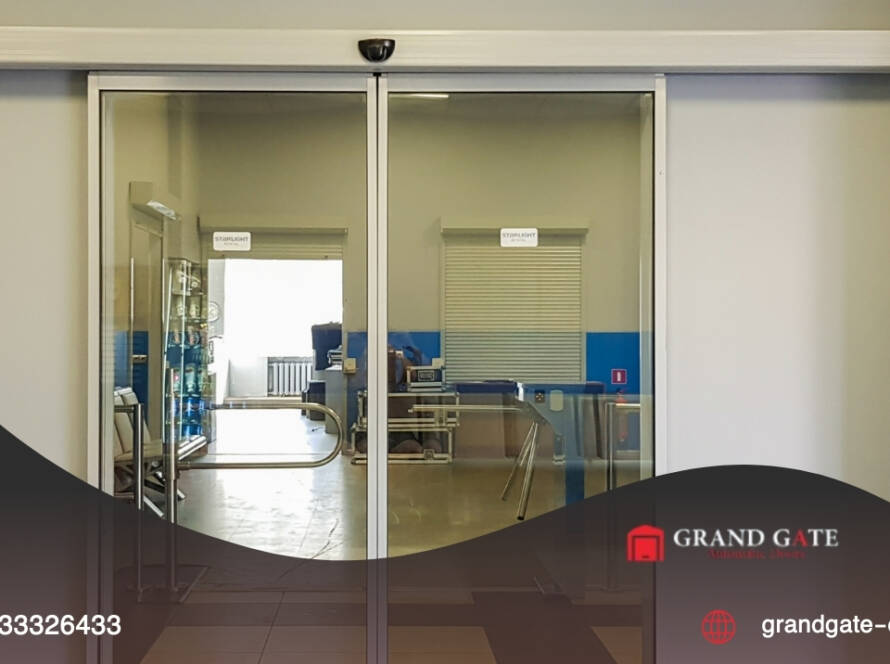
Automatic Sliding Doors
These are the most common automated entrances found in airport main concourses and baggage claim areas. They provide rapid opening cycles and a wide, clear opening path that allows multiple passengers carrying large luggage carts to pass through simultaneously without delay.
Automatic Swing Doors
Often utilized in interior terminal corridors, VIP lounges, administrative offices, and restrooms, automatic swing doors offer automated convenience in areas where space does not permit lateral sliding panels. They are easily integrated with push pads, touchless wave sensors, or proximity cards.
Revolving Doors
For main terminal entrances exposed to harsh outdoor climates, revolving doors act as an airlock. They prevent heavy drafts, dust, and wind from entering the terminal, significantly reducing energy consumption. Many large airports utilize three-wing or four-wing high-capacity revolving doors with integrated central sliding doors for peak-hour flexibility.
Telescopic Sliding Doors
In areas where lateral wall space is structurally limited, telescopic doors offer the ideal solution. By dividing each sliding leaf into two smaller panels that slide over one another, telescopic systems maximize the clear opening width by up to 30% compared to standard sliding configurations.
Hermetic Automatic Doors
These specialized doors are deployed in airport medical clinics, quarantine zones, and cleanroom environments. They feature an airtight sealing mechanism that drops and presses the door panel against the frame, preventing the transfer of airborne contaminants and maintaining precise air pressure control.
Emergency Escape Doors
Crucial for airport safety compliance, these doors function normally as sliding or automatic entrance systems but feature a “break-out” mechanism. Under physical pressure or upon receiving a fire alarm signal, the door panels swing outward in the direction of evacuation, providing an unhindered escape path.
- Sliding Doors: Ideal for main entrances and high-traffic baggage terminals.
- Revolving Doors: Best suited for climate-controlled draft lobbies and energy-saving vestibules.
- Swing Doors: Perfect for internal administrative offices and executive airport lounges.
- Telescopic Doors: Excellent for narrow corridors requiring maximum physical opening space.
- Hermetic Doors: Specifically built for airport medical hubs and quarantine areas.
Why Airports Use Automatic Doors
Improved Passenger Flow
With thousands of passengers navigating terminals at any given moment, avoiding bottlenecks is vital. Automated doors eliminate the physical barrier of manual handles, allowing continuous, fast-paced passenger movement from curbside check-in all the way to departure gates.
Enhanced Accessibility
Modern airports must accommodate travelers of all physical abilities. Automatic systems allow wheelchair users, elderly passengers, and families pushing heavy strollers or luggage carts to navigate the facility independently and with absolute dignity.
Better Security Control
Terminal security is hierarchical. Automated entrances allow facilities to restrict access to specific areas, such as customs, passport control, and staff-only zones, by interfacing directly with biometric scanners, facial recognition cameras, and keycard readers.
Energy Efficiency Benefits
Airports are massive architectural structures that consume significant amounts of energy for heating and air conditioning. Smart entrance systems minimize the time doors remain open, reducing conditioned air loss and lowering carbon footprints.
Touchless Entry Experience
In a post-pandemic world, public hygiene is a top priority. Touchless sensors prevent travelers from coming into physical contact with door surfaces, reducing the spread of germs and enhancing the overall sanitary standards of the terminal.
Reduced Congestion During Peak Hours
During flight boarding surges, passenger traffic can spike rapidly. Automated entryways respond instantly to changing flow densities, preventing physical pile-ups at narrow transit points.
- Enables rapid and unhindered passenger flow during peak operational hours.
- Maintains interior climate control to minimize HVAC energy consumption.
- Achieves full compliance with local and international accessibility regulations.
- Prevents cross-contamination through fully automated, touchless operation.
- Acts as a secure barrier that interfaces with terminal-wide security networks.
Key Features to Look for in Airport Automatic Doors
High-Cycle Performance
An airport door might open and close thousands of times a day. Specifying systems with high-cycle ratings is critical to avoid unexpected breakdowns that could disrupt passenger flow and security.
Advanced Safety Sensors
To protect travelers, airport doors require dual-technology sensors. These sensors monitor both motion (for opening) and presence (to prevent premature closing), ensuring that slow-moving passengers or abandoned luggage carts are never struck by moving door panels.
Access Control Integration
The doors must have open-protocol controllers that easily connect with common airport security hardware, such as RFID readers, biometric scanners, and smart building management networks.
Fire Safety Compliance
In the event of an emergency, automatic systems must interface with the main fire alarm system. They must automatically open, close, or switch to manual breakout mode depending on the specific evacuation strategy of that terminal zone.
Weather Resistance
Terminal entrances are directly exposed to the elements. High-quality automatic doors for airports must feature robust weather-stripping, corrosion-resistant aluminum frames, and wind-resistant structural designs to withstand severe weather conditions.
Smart Building Connectivity
Modern airports utilize smart Building Management Systems (BMS). Integrated door controllers allow remote monitoring of door statuses, allowing maintenance teams to detect faults or lock down zones from a central control room.
Airport Security Requirements for Automatic Doors
Integration with Access Control Systems
Securing restricted airside zones from landside public areas requires seamless integration. Automatic doors are configured to remain locked until a valid credential is scanned, instantly locking back into place once the authorized individual passes through.
Emergency Lockdown Capabilities
In high-threat situations, airport security must have the ability to execute an instantaneous lockdown. Authorized personnel can remotely lock all automated access points, trapping threats or preventing access to highly sensitive terminal areas.
CCTV and Security Integration
Modern doors can be synchronized with local CCTV cameras. When a door is forced open or held open for too long, an automatic alarm triggers the nearest security camera to focus on the entrance, providing real-time visual assessment for security operators.
Compliance with Aviation Safety Standards
Airport door installations must adhere to strict aviation standards, including EN 16005, ANSI A156.10, and civil aviation authority regulations. These standards govern closing speeds, impact forces, and backup power operations to guarantee public safety.
Automatic Doors and Airport Accessibility
ADA Compliance Requirements
To serve international travelers, Egyptian airports increasingly align with global standards like the Americans with Disabilities Act (ADA) and equivalent international codes. These codes dictate minimum clear opening widths, sensor detection zones, and opening speeds.
Supporting Passengers with Disabilities
For individuals with visual, auditory, or physical impairments, automatic doors remove substantial physical barriers. Voice-guided warnings and clear visual indicators on the doors further assist passengers navigating complex airport environments.
Touch-Free Access Solutions
Utilizing microwave radars and infrared waves, touch-free entrances ensure that anyone, regardless of physical capability, can move freely through the airport without needing to touch high-contact surfaces.
How to Choose the Right Automatic Door for an Airport
Evaluate Passenger Traffic Volume
Main terminal entrances require heavy-duty, high-capacity sliding or revolving doors. Secondary staff entrances or administrative areas can utilize standard sliding or swing doors.
Consider Security Requirements
Identify whether the door connects public zones (landside) to highly secured zones (airside). Secured zones require doors capable of integrating with heavy-duty locks and advanced access credentials.
Assess Available Installation Space
Measure structural openings carefully. If lateral clearance is minimal, telescopic sliding doors or bi-folding automatic doors are the best alternative to maximize the available walk-through space.
Review Climate Conditions
For airports located in areas prone to high winds or extreme heat, revolving doors or double-door vestibule layouts are highly recommended to preserve internal climate control.
Calculate Long-Term Operating Costs
While initial acquisition cost is a consideration, analyzing energy efficiency, durability, and maintenance frequency provides a far more accurate picture of the total cost of ownership.
- Step 1: Conduct a detailed passenger traffic and volume analysis.
- Step 2: Define the exact security and access control requirements for the zone.
- Step 3: Assess physical space constraints and select the appropriate door style.
- Step 4: Verify compliance with all national and international safety regulations.
- Step 5: Partner with a certified local installer like Grand Gate Eg for precision fitting.
- Step 6: Establish a routine preventative maintenance program to protect your investment.
Installation Process for Airport Automatic Doors
Site Assessment
Experienced engineers conduct precise on-site structural and environmental assessments. This includes measuring physical openings, checking structural integrity, evaluating traffic patterns, and identifying potential environmental challenges.
Door System Design
Based on the assessment, custom door configurations are designed. This stage involves choosing materials, frame finishes, sensor types, glass thicknesses, and custom safety integrations tailored to the airport’s unique aesthetic and operational needs.
Installation and Integration
Professional technicians install the structural frames, glass panels, drive operators, and safety sensors. The system is then wired directly into the airport’s security, access control, fire alarm, and BMS networks.
Testing and Commissioning
Before the door is cleared for public use, it undergoes rigorous stress-testing. Technicians verify sensor calibration, backup power function, breakout mechanics, and safety stop triggers to ensure flawless daily operation.
Ongoing Maintenance
Once commissioned, a structured maintenance schedule is initiated. This preserves system warranty coverage and ensures the automated doors continue to operate safely under heavy daily passenger loads.
Maintenance Best Practices for Airport Automatic Doors
Routine Inspection Checklist
Daily visual checks by airport facilities staff help catch minor issues before they escalate. Inspections should focus on glass integrity, guide track cleanliness, and clear sensor fields of view.
Sensor Testing
Sensors must be tested regularly to confirm they detect people of varying heights and walking speeds. Any blind spots in the detection zone must be corrected immediately to prevent accidental physical contact.
Mechanical Component Maintenance
Regular lubrication of drive gears, belt tension adjustments, hanger roller inspections, and track cleaning prevent premature mechanical wear and guarantee quiet, smooth operation.
Software and Automation Updates
Modern door controllers rely on advanced firmware. Keeping this software updated ensures optimal sensor sensitivity, improved energy efficiency algorithm performance, and seamless communication with security systems.
Cost Factors for Automatic Airport Doors
Door Type
The mechanical complexity of the door impacts initial manufacturing costs. For example, large-capacity revolving doors involve more sophisticated structural engineering and materials compared to standard automatic sliding doors.
Automation Technology
Advanced controller systems, high-speed brushless motors, and multi-technology safety sensors represent higher upfront investments but deliver vastly superior durability and safety.
Security Integration
Custom electromagnetic locks, high-security glass, breakout panic hardware, and biometric reader integrations add to the initial project scope but are critical for high-security terminal areas.
Installation Complexity
Night installations, structural modifications, specialized glass lifting equipment, and integration with legacy airport security networks can impact the overall installation project timeline.
Maintenance Costs
Investing in a preventative maintenance program reduces the likelihood of emergency repair needs, which can be highly disruptive and costly to perform during peak flight operation hours.
Why Choose Grand Gate Doors for Airport Automatic Doors
Advanced Automation Solutions
Grand Gate Eg provides cutting-edge automatic doors for airports that leverage the latest in European automation technology. Our systems are engineered to handle the relentless, high-volume traffic of Egypt’s busiest transit hubs.
Custom Airport Door Systems
We understand that every terminal has unique architectural and security needs. Our engineering team designs custom-tailored solutions that integrate beautifully with local terminal aesthetics while fulfilling strict civil aviation standards.
Professional Installation Services
Our team of highly trained, certified technicians handles the entire installation process from start to finish. We work closely with airport project managers to ensure seamless integration with active terminal security and fire safety grids.
Maintenance and Technical Support
At Grand Gate Eg, we provide round-the-clock maintenance services and prompt technical support across Egypt. Our goal is to ensure zero downtime for critical airport entrances, keeping passenger traffic moving smoothly at all times.
Investing in top-tier entrance infrastructure is essential for building a safe, energy-efficient, and smooth-running airport terminal. For premium automatic doors for airports designed to withstand the highest operational demands in Egypt, Grand Gate Eg delivers unmatched performance, robust security integration, and dedicated professional support. Reach out to our expert team today to discuss your project requirements, request a tailored technical consultation, or schedule maintenance. Call us now at 01033326433 to elevate your facility’s safety and passenger experience.